
Why some teams outperform others – and where leaders should focus to enable effective teams
You have brought together highly talented individuals with strong track records, and yet the team is not delivering. Sound familiar? Or maybe the team seems very busy, committed to their work, and yet they aren’t having the impact you expected? Or perhaps the team performed brilliantly, until something changed? So often we bring the right individuals together, but we don’t create the conditions for them to succeed. We assume that they will perform well together, because they are individually brilliant – understanding the characteristics of an effective team enables us to create the conditions where the sum of the parts can in fact become greater than the whole.
What are the attributes and behaviours of effective teams?
In this article I will share the characteristics of an effective team, drawing on both the theory and my experience with teams. I will offer some practical ‘how to’ tips. If you want to learn more I offer more practical advice in my next blog ‘How to build a high performing team’.
Characteristics of effective teams: What is an effective team?
What’s your poison in terms of sport? Mine are rugby and hurling! It’s easy in that context to establish who the high performing effective teams are, there’s silverware on offer after all! It’s trickier in the world of work.
What does the research tell us about the characteristics of high performing teams?
Katzenbach and Smith’s research-backed framework (Wisdom of Teams) offers a useful way to think about this. They chart the differences between working groups, pseudo teams, potential teams, real teams to high performing teams. High performing teams not only share the characteristics of real teams (which is in in their model: a small number of people, with complementary skillsets, who are mutually accountable for a shared purpose and goals) but also have a deep commitment to each other’s growth and success.
That level of commitment to each other is something that has to be cultivated. Amy Edmondson’s research suggests that without psychological safety – the belief that it is safe to speak up, disagree and realign constructively, without fear of judgement – most teams will default to caution. Things become undiscussable in the larger team, often discussed at length outside the room, quietly undermining the team’s performance.
Hackman and Wageman (6 team conditions) through their extensive research came up with the conditions for team effectiveness, highlighting that it isn’t just about the talent of the individuals, but rather how the team is set-up and managed on an ongoing basis. They highlight three essential conditions (real team, compelling purpose and right people) 3 enabling conditions (work design, organisational support and team coaching).
Characteristic of High Performing Teams: High Performing for Whom?
If beauty is in the eye of the beholder, then we also need to ask – who judges this performance? Authors like Peter Hawkins (Leadership Team Coaching) bring in the lens of the stakeholder to address this question. Teams at all levels in an organisation, from middle management to senior management, need to manage a diverse set of stakeholders:
The 4 layers of stakeholders that effective teams manage
- Internal stakeholders: the employees led by the team, the team members themselves, their leader, the senior leadership and the board
- External stakeholders: clients, service users, partner teams, outsourced partners and the broader organisation
- Those impacted by the team’s actions: communities, the environment and wider societal stakeholders
- The system itself: the organisation’s long-term health, culture and capacity to perform sustainably
Different stakeholders will define and measure high performance differently. The team’s job is to be clear on who they serve, how they are performing in those relationships, and where they can improve.
Characteristics of effective teams – my take and practical tips
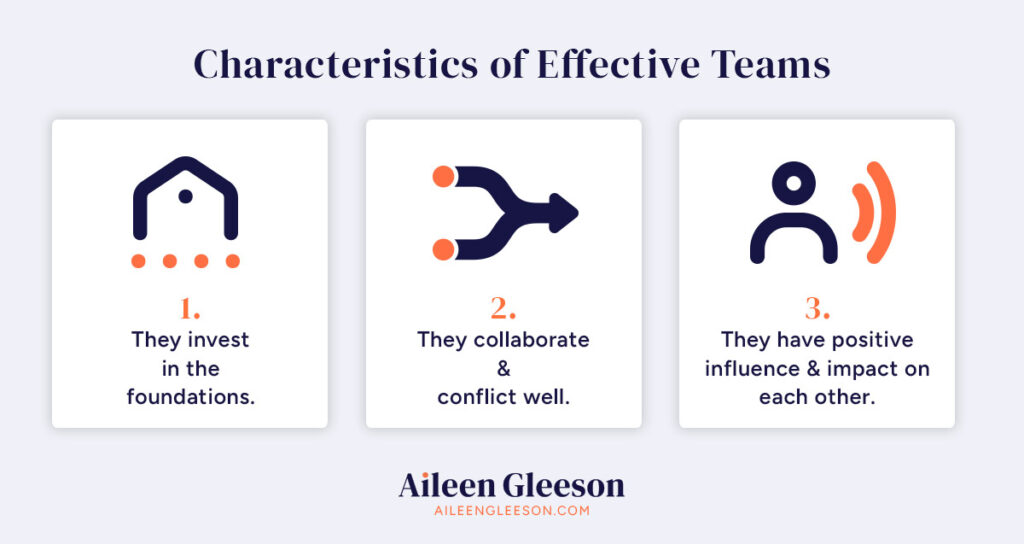
When it comes to team effectiveness I like to boil things down to brass tacks, and here are my three focus areas:
1. They invest in the foundations
- Right people – roles are complementary and people are clear on how they depend on each other
- Clarity regarding their purpose and goals and how this serves their stakeholders
- Engaging work that stretches the team – no one performs well when they are bored
- Psychological safety is a consistent focus, not an away day
TIP: Every team should review how well they are doing on these foundational elements at intervals. The easiest way to do this is ask the team and your stakeholders. For example – you’d be amazed how different the replies are when I simply ask “what is your purpose as a team?”
2. They collaborate and conflict (small c) well – with each other and their stakeholders
- High quality generative dialogue
- High support, high challenge environments that allow for flow
- Learning is a priority – they reflect on their collaboration and improve
- Being on the team makes them better – professionally and personally
TIP: I will write a dedicated blog on this, but a quick tip here: one of my favourite questions to ask team members is “what is undiscussable in this team?” This shows up where the no go areas are, and therefore what might be holding the team back – and what might be going on at the watercooler!
3. They have positive influence and impact on each other and in their ecosystems
- Leavers and joiners – people miss the team when they leave, often going on to their next opportunity, and people want to be on the team. The positive word spreads about the leader and the culture they have created
- They are the teams others want to work with – and will go the extra mile for
- Their impact is felt beyond the team boundary – by the people they serve, the partners they work with and the communities they are part of
TIP: Well, less of a tip, more an observation: we know who the good leaders and teams are. Often this means people go on to bigger and better things – but the pipeline is there, because people want to do their best work.
Teams have more potential than they realise
In my experience, most teams have more potential than they realise. The difference between a good team and a high performing effective one is rarely just about their talent – it is attention they give to the three areas above: to the foundations, to the quality of conversation, and to the impact they are having beyond themselves. More on how to get there in my next blog ‘How to build a high performing team’.