
When you come together as a team – are you able to focus on things that will actually move the dial? Do you have broad-reaching debate – leveraging the breadth of intelligence in the room, or are a few voices dominant? Can you disagree agreeably and ultimately align on the best path forward? When those decisions get made, can you easily move to implementation – or do you live through your team’s version of groundhog day? In this blog I want to share with you how to improve team collaboration.
How do we spot good Team Collaboration: OUTCOMES
If we want to assess or improve our team collaboration, we need to know what to look for. You know a team is collaborating well, not just because of what they deliver but also how they deliver it. This is not limited to looking at whether a team is achieving their goals or KPIs (we might hit the target, but have missed a crucial risk), but equally how well they are able to adapt their approach in response to changes in their environment (eg evolving risks), how well they navigate the ecosystem to drive their goals, how satisfied team members are in this team, how satisfied our stakeholders are and how much team membership can learn and grow to name but a few.
TIP: Being specific about your baseline across each of these areas, looking for improvement potential and going after them will significantly improve your results over time. Easiest way to do this – ask the team both how they feel we are doing, and how we can improve!
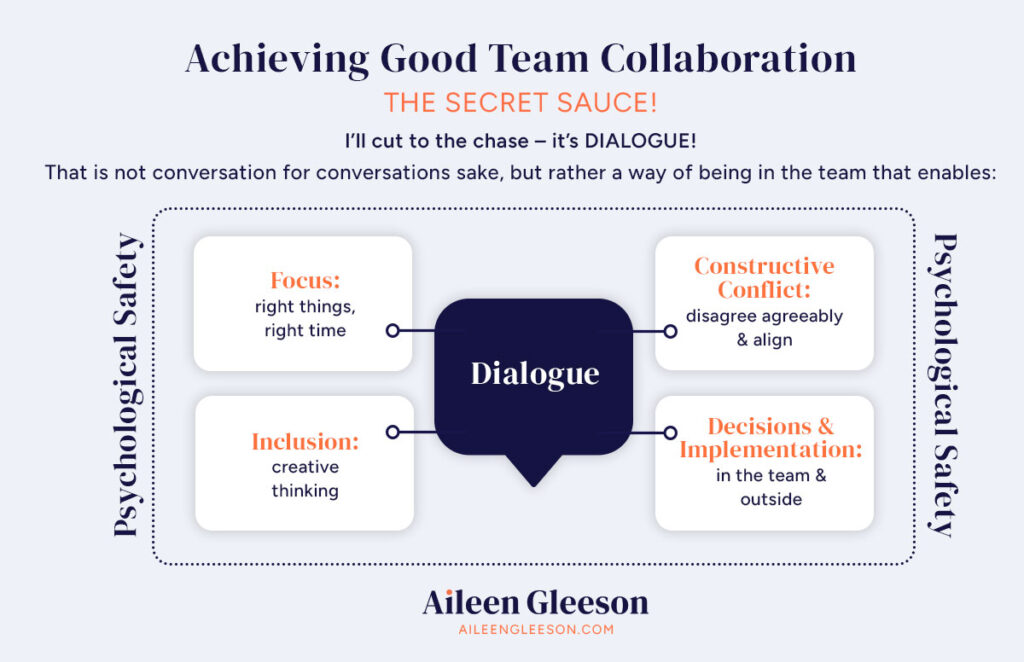
Achieving Good Team Collaboration – The Secret Sauce!
I’ll cut to the chase – it’s DIALOGUE! That is not conversation for conversations sake, but rather a way of being in the team that enables:
- Focus – right things, right time
- Inclusion – creative thinking
- Constructive Conflict – disagree agreeably and align
- Decisions and Implementation – in the team and outside
What underpins our ability to get here is psychological safety, which I believe (and studies prove) needs to be a continual focus both in set-up for an effective team and throughout a team’s continued existence. This is a topic in and of itself (which I’ll do in a later blog), but for our purposes here, it is about establishing sufficient trust in the team such that each team member feels safe to engage fully (input, challenge, support) in service of the team’s goals.
Improving Team Collaboration Starts with Focus
This one sounds deceptively easy – just focus on the right things at the right time, simple, right? And yet how many hours have we all lost in meetings that went nowhere or to the same place time and time again! I think of focus in teams in three ways;
- Focus of the Work: Do our goals and priorities actually inform what we work on together, how we prioritise new work we are asked to do, and are they still the right ones? Can we easily pivot to address emerging risks and opportunities? TIP: It’s obvious but, ask the team and be willing to hear and work with the answer!
- Focus in the Room: We all have patterns in how we think, feel, and behave, and these dynamics play out in teams too. They will either interrupt or shape the focus. Do you know yours? Do they serve you? Can you spot them, and name them in the team? TIP: Make how you are having the conversation itself a focus. Normalise the fact that all teams have dynamics and agree in advance how you want to raise and work with them.
- Focus on the Energy: I separate this from dynamics, although it’s part of them, because it’s the canary in the mine. When energy dips, it’s often a clue that something isn’t being said, or is about to be, and that it matters. This is the undiscussable hiding in plain sight. It plays out at both an individual and team level. Our instinct is usually to do something to lift the mood. That’s a missed opportunity. TIP: If the energy shifts, get curious instead. A simple question, like “what’s going on right now?”, can unlock so much.
Improving Team Collaboration and The Case For Inclusion
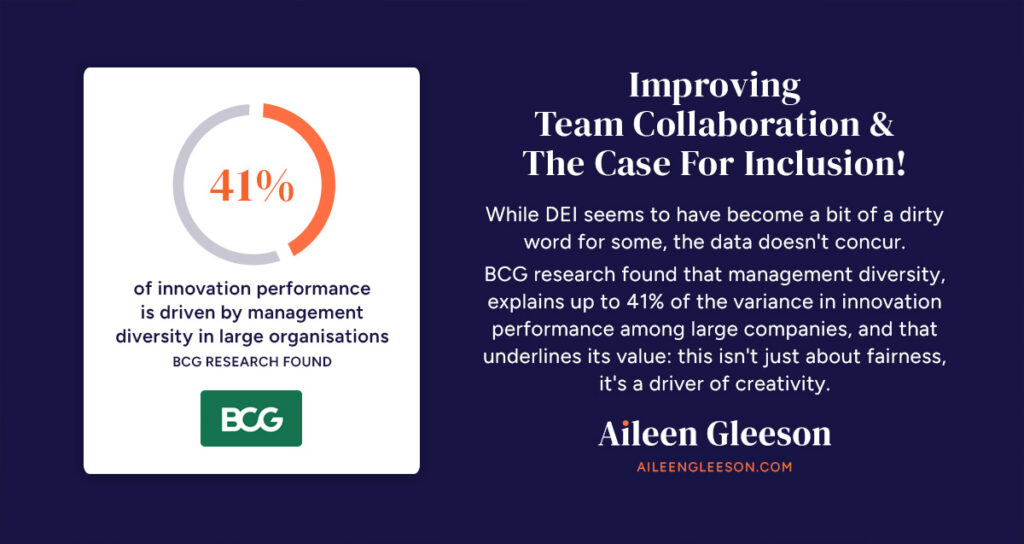
While DEI seems to have become a bit of a dirty word for some, the data doesn’t concur. BCG research found that management diversity, of both middle management and senior, explains up to 41% of the variance in innovation performance among large companies, and that underlines its value: this isn’t just about fairness, it’s a driver of creativity.
Inclusion in a team isn’t just “ask everyone for everything.” That can be quite frankly exhausting, and even sometimes the wrong thing to do. Part of working well together is being clear about who needs to own a decision and who doesn’t, so people aren’t dragged into every conversation out of politeness. The real test of inclusion isn’t whether everyone says something, although noticing who’s gone quiet and drawing them in is still important. It’s whether, when different perspectives arise, the team can actually hold the tension between them, rather than rushing to resolve it, often in favour of the loudest or most senior voice. Is it possible for us to sit with two distinct views and not force a premature choice? If we can, we will find that dialogue allows us to understand more about both views and can even be a catalyst for other options to emerge. TIP: Next time you notice disagreement in the room, resist the urge to pick a side and settle it. Ask team members to suspend their feedback on the perspectives for now and instead invite them to ask questions that help them understand each perspective better. At the very least you will learn more about the choices, and often so much more.
Improving Team Collaboration Requires Constructive Conflict
Conflict is a topic that is as broad as it is long! In our context here, I want to share the need for constructive conflict in teams (disagreeing agreeably, ala the rest is politics!) and how to navigate through it in service of:
- clarity (where do we have different perspectives)
- creativity / innovation (we need multiple differing perspectives to come up with better ideas)
- decision making (agreeing the path forward)
- real alignment (owning the decisions as a team, not undermining them outside the room)
- responsiveness to changing circumstance (being able to name what isn’t working)
Often we prefer to avoid or smooth over, but it doesn’t go away and can operate very powerfully in the background.
Patterns of Conflict in Teams
On a practical note below are some of the common patterns of conflict I see in teams, and some suggestions for how to work with them:
- This is just a misunderstanding: Sometimes people don’t hear what we think we said. It might be our communication, or their listening, it really doesn’t matter which. What is needed is clarity quickly, so we can move on. TIP: Ask: “Can I just check, what did you hear me say?” And then clarify if it is not what you meant. You would be surprised how often people acknowledge that they misunderstood.
- We are describing the same thing in different ways and think we are disagreeing: This one is usually caught by the others in the room first – you see it in quizzical faces, often as the argument continues. Someone needs to call it. The good news is that at least we are agreeing on the problem statement, even if we don’t realise it! TIP: Ask for a pause, and own that you aren’t hearing the difference in the arguments and seek clarity.
- We are disagreeing on the strategy of how to move forward (eg fix the issue): The good news is if we are disagreeing on strategy, then we are at least aligned on the need at the heart of our discussion. This is where we need to agree how we rate the competing strategies. Our purpose, goals and priorities are useful in this context. As is of course the current evolving landscape. TIP: Ask the team to agree the process for how to prioritise and apply it to this problem statement. Then evaluate how well the process is working and what needs tweaking.
- We are disagreeing on the needs, or the priority of the needs in this situation: This is the trickiest of all. These are often the most passionate of discussions and need more dialogue, and great holding. As per point 3 our purpose, goals etc, our understanding of the current landscape is needed and potentially more eg data, stakeholder perspectives etc. There is no easy fix. TIP: Name the needs being surfaced, name any variance in prioritisation of those needs. As per point 3, the team will need to own how they agree to prioritise. It may be useful to get external help to navigate.
One caveat worth mentioning, is that sometimes the conflict is personal. The solutions for this may not reside in the team, but rather with the people involved, their managers etc. And now a caveat to my caveat: sometimes what we assume are interpersonal issues, can be competing business needs, or a role or structure in the system that’s setting two people up to clash regardless of who’s in those roles. For most of us, we can get along in work with people we might not want to socialise with – so it is always worth looking at the system.
Improving Team Collaboration means Deciding and Implementing!
If focus, inclusion, and constructive conflict have been done well, we’ve actually done a lot of the heavy lifting. Now it’s all about momentum – moving forward into action, and we can get in our own way. Below are some of the gotchas it’s useful to look out for.
- Do we actually agree on what we decided? This sounds obvious, but the devil is in the detail, so it is worth getting specific about what we agreed, who we have signed up to it, timeframes etc. TIP: Before you leave the room (or the call), ask someone to say back what they think was just decided, and check that we all agree. It takes a few minutes and avoids misunderstandings (potentially hours of your time) in the future.
- Avoid analysis paralysis, to get momentum: This is where discernment is needed – if things are constantly being revisited (and this happens a lot), is this because there is new information or because we are risk/decision averse? TIP: We need to notice it happening and call it out! And sanity check whether anything has actually changed.
- Engage stakeholders and the wider system: Implementation requires us landing this in our system with all the stakeholders that are impacted. The tactical level to this is agreeing who needs to be engaged and how we need to engage them. Push-back from stakeholders might be resistance, or it might be information that can enhance how we implement. TIP: Make space to listen to the system feedback in the team. Get curious about resistance and any new information. Use it to frame how you respond.
- Respond vs react to change: Circumstances will keep moving after the decision is made, that’s a given. The skill is telling a genuine shift in the landscape versus resistance to change (in us or others), versus new input that you need to respond to. TIP: When something changes, or you get new information – get curious about it with the team and assess what it’s telling you.
At the heart of these four elements of team collaboration is the quality of the dialogue the team is having. I hope the tips have been useful, and I’ll dive deeper into team coaching and the art of dialogue, because it is an art, not a science, in a later blog.
Improve Your Teams Collaboration
For now, it could be useful to assess which area you find hardest, focus, inclusion, constructive conflict, or decision and implementation, and start there with your team. And if you’d like support putting it into practice with your team you can contact me online now.