

Has your team been through a restructure or a change in leadership/membership and never really settled? Have the goalposts shifted: a new strategy or changes in the competitive landscape that mean your current ways of working will need to change? Or did the team come together quickly, under pressure, so the basics aren’t in place? If any of those sound familiar, it might be the foundations you need to look at.
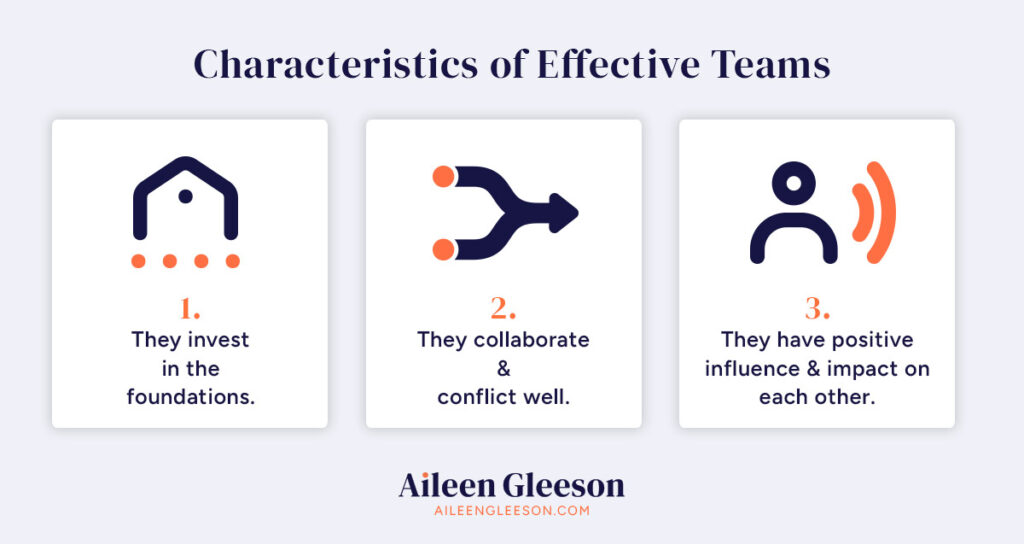
In my my previous article on characteristics of an effective team I identified three areas that enable team effectiveness – investing in the foundations, collaborating and conflicting well, and having impact beyond the team.
Foundations of an Effective Team
Here I want to go deeper on the first of those – the foundations. They can feel unglamorous, even generate a good eye-roll (who doesn’t love one!) and if you’ve experienced them as a tick the box exercise, probably evoke a ‘not again feeling’. However whether the team is new, or needs a reset – this may be the place to start.
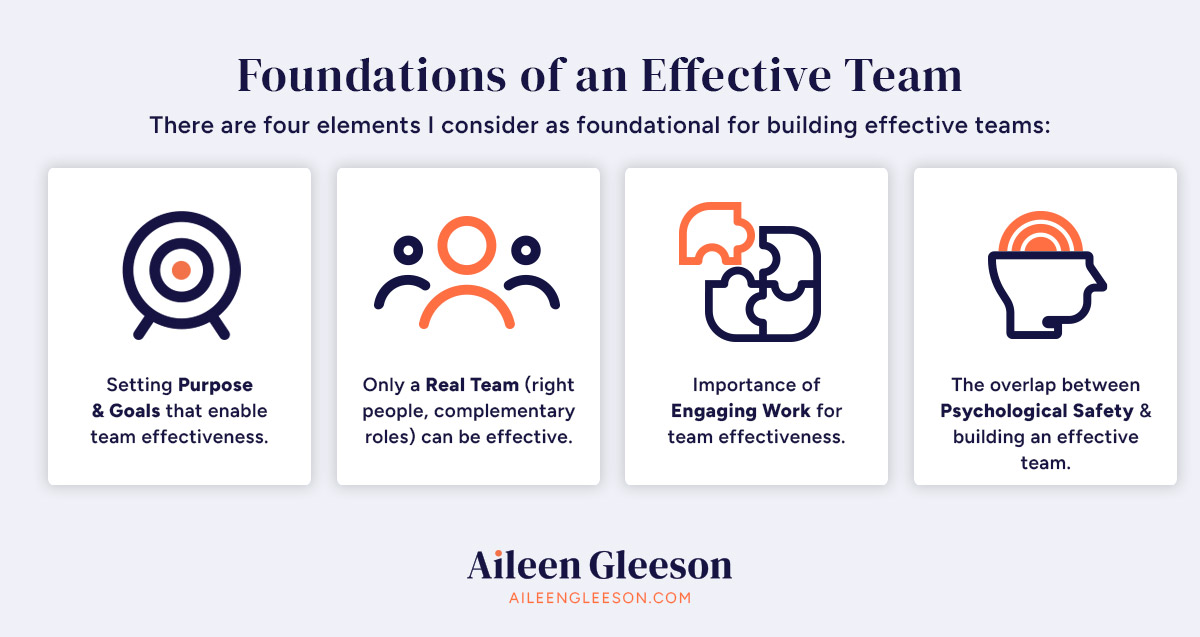
There are four elements I consider as foundational for building effective teams:
- Setting Purpose and Goals that enable team effectiveness
- Only a Real Team (right people, complementary roles) can be effective
- Importance of Engaging Work for team effectiveness
- The overlap between Psychological Safety and building an effective team
Setting Purpose & Goals that Enable Team Effectiveness
Gallup’s research consistently finds that clarity of purpose is a strong driver of engagement – and yet ask five members of the same team what their purpose is and you will often get five different answers. That is the first problem. The second is that even where there is alignment on purpose, it might not inform the goals and priorities that drive day to day work. And even when it does, other asks come in, scope creep happens, and the team gets very busy – but busy doing the right things? Stakeholders can get forgotten too – teams can become so internally focused that they lose sight of who they are actually serving. The test is simple: when your team faced its last hard decision, did your purpose help you make it? If not, why not?
Some questions worth asking:
Internal Alignment
- Are we clear on our purpose; aligned behind it; motivated by it?
- Could our people articulate it unprompted?
- Do we understand how it links to the company’s overarching direction?
- Does our purpose still fit – or has the context changed around us?
Prioritisation of the Work
- Can we draw a clear line from our purpose to our priorities?
- Are those priorities translated into clear goals that people own?
- When we are asked to take on new work, what informs our reprioritisation?
Stakeholder Focus
- Do our stakeholders know what we are here to do?
- Do we understand what our stakeholders need from us?
- Are we delivering – and how do we know how well we are doing?
Only a Real Team (right people, complementary roles) can be Effective
Hackman and Wageman’s concept of a “real team” is that it is a bounded, stable group who genuinely need each other to get the job done. Do we have the right people to enable our purpose, or is any role missing? Similarly, does everyone need to be there?
You would be amazed how often I hear “I’m really not sure why I am needed here.” This is where JOMO comes in – the joy of missing out. People can be included with the best of intentions, but if they don’t need to be there continually, they should probably just pick up the notes. Because everyone in the room will contribute – to the dynamic, the decisions, the energy – whether they need to be there or not. And who is actually on the team? It sounds like a simple question, but in my experience it is often less clear than people think.
Then there is the question of commitment. Split loyalties – where someone’s primary allegiance is to their home team or another team (LT, project team etc) – rarely get discussed directly. But it should.
Team Composition
- Do we have the right people – the right skills, perspectives and roles?
- Is anyone here who doesn’t need to be consistently – could they just pick up the notes?
- Is anyone missing?
Interdependence and Role Clarity
- Do we genuinely need each other to get this done?
- Is each person clear on how their role connects to the team’s purpose?
- Are our dependencies on each other clear and working?
Commitment
- Is this team people’s primary commitment – or are they pulled elsewhere?
- When home team needs conflict with this team’s needs, how do we handle it?
- Is anyone unclear why they are here – or actually trying to get out?
Importance of Engaging Work for Team Effectiveness
Think about the best team you have ever been in. The conversations had energy, the decisions mattered, you needed each other to make them. Now think about the worst. Update after update, information you could have read in an email. Hackman and Wageman are clear on this: the work the team does together should require real interdependence – where my decision affects yours and yours affects mine – it should be meaningful to the people doing it, it should stretch the full range of skills / perspectives around the table, and it should be bounded clearly enough that the team can genuinely own it (can make the decisions). Csikszentmihalyi’s concept of flow makes the same point differently – people perform best when they are challenged, not bored (eg by death by powerpoint). The cost of getting this wrong is not just a bad meeting. It is the conversations that don’t happen, but are vitally needed, while we are focusing on things that just don’t deserve the same amount of attention.
Work Design
- Is the work we do together genuinely worth our time? Does it need all of us?
- Is it meaningful to the people doing it – or just important to the organisation?
- Does it stretch us – or has it become routine?
- Is it clearly bounded enough that we can genuinely own it?
Structure and Focus
- What could be handled outside the room – by email, or in one to one/smaller group conversations?
- Are we creating space for the work that genuinely needs collective thinking?
- Do people have enough autonomy in how they approach the work? Can they make decisions?
The Overlap Between Psychological Safety and Effective Teams
Psychological safety is not a nice to have. It is what allows the team to have the conversations that matter, that can often be avoided. It is not an away day or an exercise, and I am including it here because it is important to think about it from the outset. Edmondson’s research is clear that the patterns established early are very hard to shift – people learn fast what is safe and what isn’t. Who speaks first, who gets airtime, whose ideas get built on. And how the team handles its first failure is particularly influential. Her thinking in “Right Kind of Wrong” identifies three types of failure: basic, complex and intelligent. Psychological safety ensures that basic and complex problems get surfaced and tackled. But it is also what enables intelligent failure – the kind that happens when you try something new. This is what enables innovation and growth.
So what can a team leader do? At set-up, or if you are doing a reset, here are a few tips:
- Model it first: Share your own uncertainty, vulnerability, invite challenge, and when someone disagrees with you, get curious rather than defensive. This gives the team the blueprint and the permission to disagree agreeably.
- Make inclusion deliberate: Don’t let the same voices dominate early meetings. Create space – slow the conversation down, ask directly, make it normal to hear from everyone.
- Name how you will handle failure: Have an explicit conversation about how you as a team will manage failure. A mantra I have lived by is that bad news needs to travel fast, so we can use the power of the team to address it.
- Make the undiscussable discussable: Early on, ask the team: what are we not talking about that we should be? And continue to ask this question at intervals. The answers may bring discomfort – but working through that as a team, creates team resilience and trust.
If your team is already established, these questions might tell you whether a reset is needed:
- Do people say what they think in the room – or after it?
- When something goes wrong, is the first instinct curiosity or blame?
- Do people feel safe enough to try something new and fail?
- As a leader, what do you do when someone disagrees with you?
Build Your Team Effectively
Still wondering whether your team’s foundations are solid? An outside perspective often helps. Contact me online now to see how we can work together. And if your foundations are in good shape but you know there’s a next level to reach, my next blog looks at team collaboration.