
Middle Management – The Engine That Delivers!
The organisational layer that translates the vision/strategy/culture into concrete action is the middle – and they need to be well resourced and supported to do that. If they aren’t, the organisational cost is significant. It shows up in disengagement, poor performance, and an erosion of the trust that is essential to delivering results effectively. I’ve spent a decade supporting both senior and middle management across a range of organisations – and this pattern shows up consistently. So, what can leaders do to support them?
Firstly: ‘The Torn Middle’ – what systems thinking tells us about middle management problems
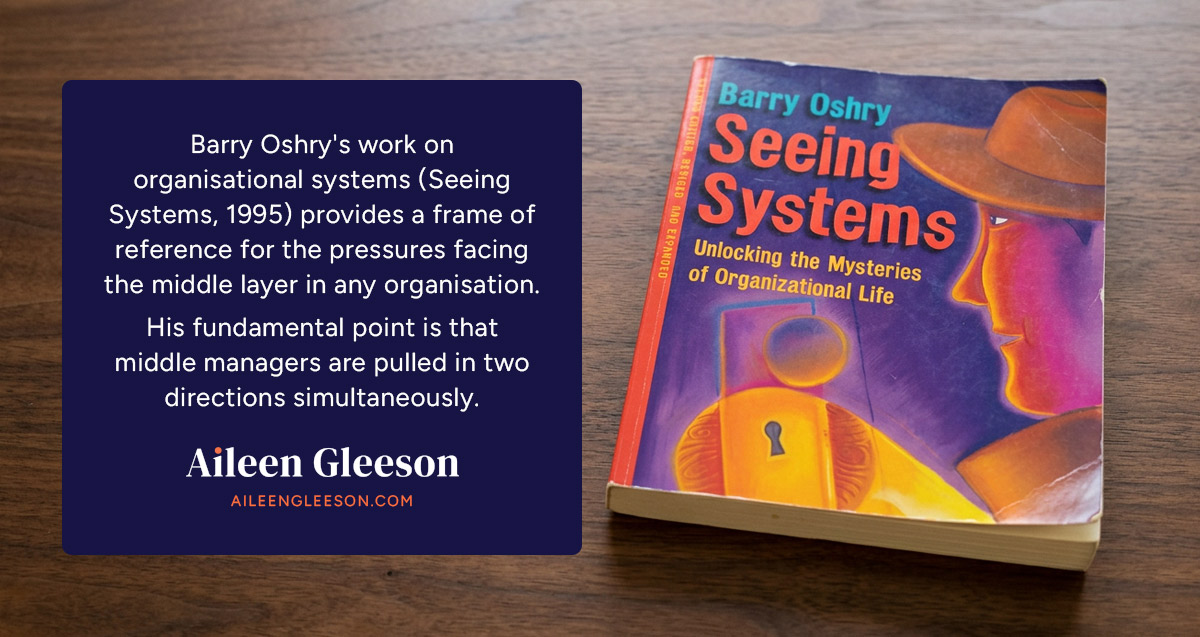
Barry Oshry’s work on organisational systems (Seeing Systems, 1995) provides a frame of reference for the pressures facing the middle layer in any organisation. His fundamental point is that middle managers are pulled in two directions simultaneously. They need to translate and operationalise the vision/strategy/culture and mediate this with those they lead, ensuring that their voice is equally heard. Middle management responsibilities are wide-ranging. They absorb the complexity of the system – the competing needs of stakeholders, shifting priorities, at times limited information – often without the power to fully resolve it. He highlights that they can effectively feel torn apart, not because of who they are (their own inherent abilities), but because of where they sit in the organisation.
Seeing this from both sides
Having sat with both sides, the song in my head is from Queen – ‘Under Pressure’. And whilst no two client engagements are the same, pressure can come with a typical set of very human responses: blame, anger, frustration, worry, fear! It runs the gamut, and impacts both sides. These emotions create stories that start in people’s heads, get shared with peers and can quickly take on a life of their own. What I sometimes encounter is an unwillingness to bring these dynamics out into the open, and even when that willingness is there, a sense of not knowing how to have the conversation constructively. And this can become a vicious cycle.
So what? What can leaders do to activate the critical engine that is middle level management?
The world is complex enough, so I like to boil things down to brass tacks. I think about this in three ways:
- Getting the fundamentals right and firmly in place
- Putting your own oxygen mask on first
- Engaging with the middle – dialogue
The fundamentals:
Simply put (though not easy), leaders need to:
- Provide the organisational framework (vision, mission, strategy, culture, organisation design) and be able to evolve it in response to change
- Ensure clarity around expectations (eg R&R’s, business plans, processes, policies)
- Lead and manage well – inspire, motivate, develop, empower and delegate
- Engage in proactive stakeholder engagement (expectation management)
The degree to which these are in place and functioning ‘well enough’ (because there is no perfect), provides the foundations for all employees to do their best work.
As the Leader you need to put your own oxygen mask on first!
None of us are ‘fully baked’ – and our growth edges become very visible under pressure. The good news, if you can see it that way, is that everyone has something to work on! When you understand your own support needs and resource yourself well, you have the internal grounding to tackle whatever leadership throws at you.
Research also shows that a leader’s mood is literally contagious, shaping the emotional tone and performance of their entire team (Sy, Côté & Saavedra, 2005) and that emotions transfer through the organisation unconsciously and influence cooperation, conflict and task performance (Barsade, 2002). So, when the oxygen mask is missing, everyone feels it.
So, what can leaders and managers do? Here are some suggestions:
- Establish your areas for growth – through trusted feedback or a diagnostic
- Tap into available support – coaching, mentoring, education – and identify any additional needs
- Develop good self-management strategies and build your resilience
- Build a trusted network of peers and mentors that can support
Engaging with the needs of middle management – the role of Dialogue
This is not about more meetings – it is about creating deliberate space to support your managers. Some practical suggestions:
- Creating targeted 1:1 time with your managers: making regular space for their development, coaching and mentoring them, and understanding where they are feeling torn.
- Building a strong cohesive and supportive Leadership Team: the demands on teams either see them pull together and rally to support each other or can drive fragmentation and difficult dynamics. Working on team effectiveness can enable teams to buffer the pressure and increase both their support for each other and ability to challenge one another
- Facilitating a strong peer network amongst your middle managers: encouraging them to build supportive peer relationships so they learn from and support each other. Some organisations do this through coaching circles or group coaching programmes. These are also some of the most effective forms of middle management training – embedding new skills in a real, supported context rather than just in the classroom!
- Targeted stakeholder engagement: working with managers to map and manage the stakeholders who place the greatest demand on their time, senior leaders can build engagement strategies to help reduce the churn over time
- Instituting JOMO for yourself and your team: JOMO – the joy of missing out – is about being intentional about where your presence adds most value, trusting others to represent where needed, and catching up on notes afterwards.
Middle management is the engine that keeps organisations running. The investment leaders make in supporting this layer is not a nice-to-have, it’s a highly consequential priority!
If this resonates and you’d like to explore how I can support you, I’d love to hear from you. Reach out here.
Middle Management Frequently Asked Questions
How do I know if my middle level management is struggling – before it becomes a serious problem?
The simple answer is to ask them – using your regular meetings with them to get beyond the content of their delivery (the ‘what’) and understand how they are feeling about their work and where they might be struggling (the ‘how’). People can continue to deliver the results you need despite being overwhelmed or even near to burnout. A coaching approach in your 1:1s creates the space for this conversation and helps you understand where you can better support them.
Is this really a senior leader’s responsibility – or a HR one?
HR can design the frameworks, programmes and policies that support manager development – but the day-to-day experience of being supported comes almost entirely from the relationship with the senior leader above them and their colleagues. Ensuring your managers tap into HR support is important – but you are critical to their everyday experience.
I have good working relationships with my direct reports, the problem is between them – what can I do?
I often hear this – and it is worth naming. Good individual relationships with the leader don’t automatically translate into a well-functioning team. Your role as leader is to actively create the conditions for the team to work well together – and that is a different task to managing people individually. It means putting the foundations in place (purpose, roles, norms etc) and doing the ongoing work of building trust and improving the quality of dialogue between people. When teams invest in this, it shows up in the trust between members, how people feel about their work and ultimately in performance.
Isn’t there a training course that they can take, eg resilience?
Training is useful – it builds knowledge and opens up new ways of working – but it is not a silver bullet either. In my experience, the most effective approach combines middle management training with 1:1 coaching and/or peer group learning – and critically, managerial follow-up as people implement what they’ve learned. Without that support, most people revert to type. Sound familiar?
Leadership Coaching, Development & Training
I help organisations build their leadership capability. I don’t have a one size that fits all, because in my opinion that doesn’t exist – or if it does: it’s a sheet (great for beds, or ghost costumes at Halloween, but not necessarily what you need)! I tailor my offering to the need that we align on, maybe executive coaching or team coaching, or a leadership development programme. If I can’t help, I often know people who can and I will point you in their direction. If you want to learn more about how I can help you, please reach out here and we can schedule a call to discuss!