
Does your team avoid conflict in the room, only for the real conversation to happen in side chats later? Has a small disagreement ever exploded out of all proportion, less because of the issue and more because of everything that came before it? Does it feel like conflict never leads to clarity or resolution and just takes too much of your energy? If any of that sounds familiar, keep reading to learn about how to manage conflict within a team.
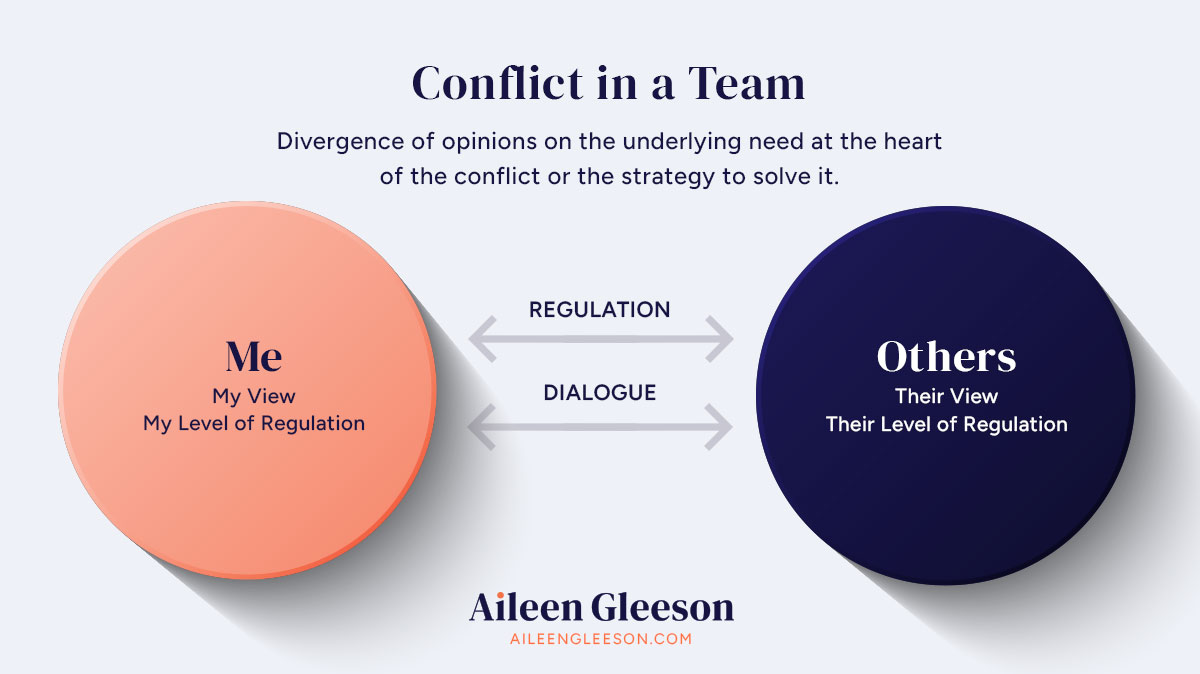
How to Deal with Conflict in a Team: A Framework
Over this and my next blog, I want to share with you some thoughts, resources and tips for dealing with conflict in your team. The framework above, outlines what I believe are the key factors. Cliff notes version here: if it is a conflict about work (and not interpersonal difficulties), it is mostly difference of opinion about either the ‘need’ at the heart of the conflict or the ‘strategy’ to resolve it (more in part 2). Our greatest resource in any conflict is ourselves (ME): our ability to self-regulate, which enables our ability to read the room and have a constructive impact on what is unfolding. Of course, our input does not occur in a vacuum, so the capability of others in the team to self-regulate is equally at play. Fundamentally our capacity in a team to regulate sufficiently is what allows us to have good dialogue (the cornerstone of any conflict resolution) and dialogue can equally create the conditions where people can regulate. In this blog I will focus on strategies for self-management which also improve our ability to read the room.
Managing Conflict in a Team: There is no I, but there is ME!
In managing any situation, we are either our own best asset or our worst liability! Hence the ME in team conflict. When clients in my executive coaching practice focus on conflict management – we work firstly on their ability to recognise when they are dysregulated and then how to regain and maintain composure.
In thinking about managing ourselves it is useful to work with all our available intelligences, ie head, heart and gut:
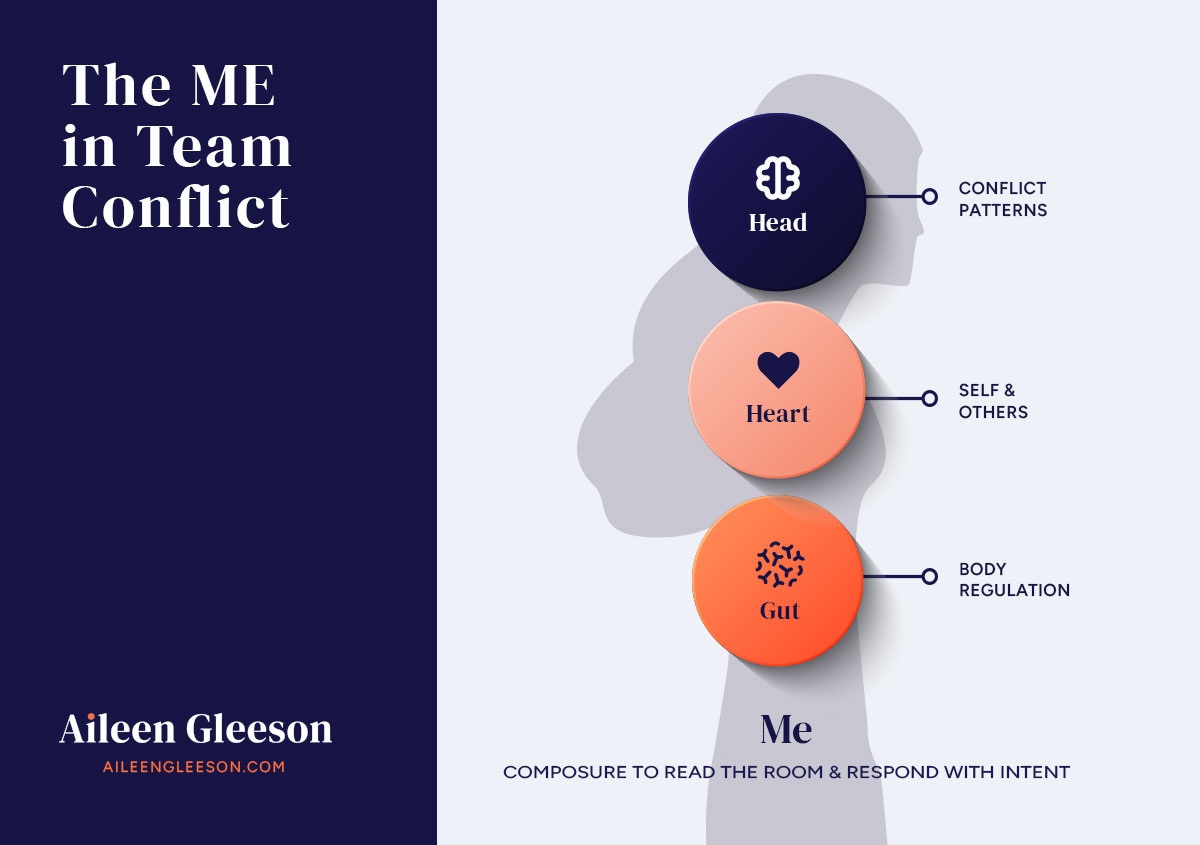
(HEAD) Intellectual understanding: do I understand how conflict works generally and more specifically for me? Here are some resources that can help you understand yourself in conflict (there’s loads on YouTube if you want to go deeper):
- The Thomas Kilmann Conflict Model provides an overview of how we respond in conflict and helps us identify our own patterns (Take the Thomas-Kilmann Instrument | Improve How You Resolve Conflict). Understanding our patterns in conflict, allows us to ascertain where our ‘go to’ places are, particularly when we are under pressure. None of the modes he outlines are ‘better’ or ‘worse’ (avoiding, accommodating, compromising, competing, collaborating as a team): the aim is to use the mode that is needed based on the situation at hand. If I avoid dealing with an issue because I don’t know how to resolve it, I am just delaying the inevitable. Avoiding focusing on the ‘red herring’ – that’s a good call.
- Stephen Karpman’s Drama Triangle helps us understand how conflict can escalate and go around in circles. It names three roles we unconsciously slip into under pressure: the Victim (“Why are you doing this to me? This is so unfair!”), the Persecutor (“Nonsense! This is your fault”), and the Rescuer (“I’ve got this! Let me fix this for you”). Knowing these stances helps us recognise when we slip into them, so we can course correct.
- David Emerald’s Empowerment Dynamic offers a positive alternative to each role: the Creator instead of the Victim (taking responsibility & action, not running with the feeling of being put upon or done to), the Challenger instead of the Persecutor (holding to account, not blaming), and the Coach instead of the Rescuer (supporting, not taking over).
These models allow us to think about conflict – the role that both I and others play in it.
(HEART) Emotional Intelligence: If you want to understand your current ability in conflict, Emotional Intelligence (EI) Psychometrics can be another great resource. Navigating conflict is only one aspect of EI – there are others – but I’m highlighting it here because EI is a core muscle you will use in any conflict scenario. Instruments like the ECR (Emotional Capital Report) and the EQi 2.0 (Emotional Quotient Inventory) are useful. Both instruments can give you a working baseline for your EI:
- your ability to understand yourself
- your ability to understand what is going on for others
- and your ability to use this understanding to get to positive outcomes in all facets of your professional life
Honing the muscle of EI, allows you to build your ability to stay in the discomfort of conflict, getting better at understanding it from multiple perspectives, in service of better outcomes all round. With a 360, understanding how you view your abilities, and equally what others see, can be illuminating – so many of my clients underestimate their strengths, or even discount them, and can have blind spots when it comes to their weaknesses.
Furthermore, these instruments can highlight differences in how our various stakeholder groups see us, and be fertile ground for exploration: how is it that my direct reports see me as very self-confident, while peers and senior leaders aren’t seeing this? Why does my confidence dip in these settings, and what can I do about it?
These models allow you to baseline and bank your strengths and understand where you can improve.
Somatic Intelligence: Understanding conflict and how it works (head), understanding our own current baseline (heart, EI) are useful building blocks – the key to managing in the moment, is our ability to stay regulated. Emotions are energy, and that energy shows up in the body – so improving our EI depends, in large part, on our ability to track what’s happening to us physically, in response to whatever situation we’re in.
Dan Siegel and Pat Ogden’s Window of Tolerance describes the zone we can operate in when we are at our best – thinking clearly, staying curious, responding rather than reacting on auto pilot to the situation. Conflict can push us out of that zone, in one of two ways:
- Hyperarousal: we are overwhelmed, reactive, defensive (easy to spot)
- Hypoarousal: we are shut down, numb, maybe even checked out (we can easily miss this one, assuming silence is acceptance)
Why is this important? These are normal human reactions, that you can become better at spotting in yourself and others – and can respond to, enabling yourself or the other to come back to the window of tolerance. This is where conflict can be resolved constructively.
The earliest signs of dysregulation show up in the body: maybe a held breath, a tightness in your chest, shoulders being held up, a rush of energy in the body, cold hands. Most of us were never taught to notice this, so we miss the signal and only catch up once we’re already reacting.
So, what can we do about it?
- In advance of potential difficult situations, Amy Cuddy’s work provides ‘power poses’ that help us to optimise how we feel. The basis for this appears to be psychological rather than hormonal as initially thought. Either way, it is a great reminder to go beyond just the preparation of the content we want to bring and focus on preparing ourselves for the interaction itself – regulating our state (however we have learned to do that) and deciding how we want to feel and show up.
- Then in the room: being somatically aware is useful. Check in with your body, how are you sitting? Can you bring more ease to your body, taking up more space? Add in a few calming breaths, and you’re sending your body the right signals – safety, confidence.
- Then during heightened anxiety:
- For you: can you catch where you are feeling it, and allow your breath to bring more ease to it? The physiological sigh is one of the most resourcing/calming breaths (two deep inhales and one long exhale, which with practice does not have to be visible to others) – a few of those will calm your nervous system. Effectively can you develop and practice strategies which allow you to use your body as a resource, a safe haven when things are difficult?
- For others: if you are regulated, can you spot who isn’t? In the following blog, I’ll go through some ways we can engage at an individual or team level to enable regulation.
- Reflection after: can you get some time after these situations to reflect, so that you can learn more about yourself: what did you notice, what did you do, what worked, what didn’t, what might you do different the next time? What did you notice in others?
If you already have strategies for self-regulation, learning your body’s signals in stress, allows you to notice in the moment when you need to use them. If you don’t, I have found breathwork and techniques from leadership embodiment (eg how to come back to centre under pressure) immensely valuable. It can be useful to have support as you hone your somatic and emotional intelligence under pressure: is there a trusted colleague you can reflect with, a mentor or a coach? For those that want to go deeper still – traditions like Leadership Embodiment (LE), offer practices that can really help us. Paul King, who I have had the privilege to train with, among others offers training courses in LE in Ireland, UK and across Europe, see here for more information The Beyond Partnership Embodiment & Somatics – The Beyond Partnership.
The gift in managing yourself better in conflict, is also that you have a better chance to be able to intervene positively. You also gain a deeper understanding of what might be going on for others, which further improves your ability to create the space for resolution.
How to Deal with Conflict in a Team: It’s about ME and the OTHERS
You might be wondering when I will get to the team – given the blog format, that will have to be part two (coming next). You might also be questioning my choice of title, given my focus here! Rightly or wrongly – you be the judge – that was an active choice, on my behalf. Fundamentally the greatest agency we have, is in how we are able to show up. If we can change that, we will affect change in others. We can’t know their reaction – but something will shift, and we can work from there. Effectively, it gives us empowerment and can help us to start to recognise the very human traits in others, giving us a chance to understand them better, instead of being potentially triggered by them.
If this resonates and you’d like support building your own or your team’s capacity in this area, feel free to reach out.